
Hallmark identification is a process of recording and comparing evidence, not a shortcut to a single answer. On jewelry and silver, a small group of marks may describe metal fineness, the assay office, a sponsor or maker, a date letter, an import route, or a design registration. Start by documenting every visible mark and the object around it. Then compare the complete group with a source that covers the right country and period. Mark & Era can help you organize a photo-led research question, while a professional assay, appraisal or authentication remains a separate service.
What Hallmark Identification Can and Cannot Tell You
A hallmark is usually a set of marks applied to precious metal under a testing or marking system. The word is often used loosely for any stamp inside a ring or on the back of a brooch, but a maker's mark, a purity number and a decorative logo do not automatically have the same status. Hallmark identification starts by separating those roles instead of treating every symbol as one code.
The most useful first questions are where, what, when and who. Where might the item have been tested or sold? What metal or fineness does the mark claim? When could that form of the mark have been used? Who is represented by the sponsor, maker, importer or retailer mark? The answers narrow a search, but they still need to agree with construction, wear, dimensions and provenance.
A photograph is an excellent record of a clue and a poor substitute for a physical test. Lighting can hide a worn punch, a copied stamp can look convincing, and a replacement clasp can carry a different mark from the original body. Use the result as a research lead, not as a certificate.
- Purity or standard mark: a claim about metal fineness in a particular system.
- Assay or town mark: a clue about where testing or marking took place.
- Sponsor, maker or importer mark: a clue about the responsible party, not always the craftsperson.
- Date, duty or registration mark: a time or administrative clue that needs regional context.
Record a Jewelry Hallmark Before You Interpret It
Good hallmark identification begins with a neutral record. Do not start by searching the most familiar logo and then crop every observation to fit it. Write the marks from left to right, note their order and draw a quick shape map. Include spaces, dots, crowns, animals, shields, letters inside outlines and any faint punch that looks incomplete. If a character is uncertain, use a question mark rather than silently converting it into a number.
Take photographs before cleaning or polishing the piece. A complete item view shows scale, design and construction; a straight-on mark view preserves the relationship between the punches; an oblique view can reveal shallow impressions. Place a ruler or a familiar object nearby for scale, but do not cover the mark. Avoid flash glare on polished metal and keep the original full-resolution files.
- 1. Show the whole itemPhotograph the ring, pendant, chain, spoon or brooch so the mark can be checked against its form and construction.
- 2. Capture the complete marked areaKeep the surrounding surface, clasp, shank, foot or reverse in frame; a cropped symbol loses context.
- 3. Add a straight-on close-upUse diffuse light and steady focus for letters, numerals, outlines and the spacing between punches.
- 4. Record conditionNote wear, repairs, solder, plating loss, replaced parts, scratches and any area that looks ground down.
Read Purity and Metal Marks in Context
Numbers such as 925, 800, 750 and 585 are familiar fineness conventions in many markets, while 10K, 14K and 18K describe karat systems used in jewelry. The number is a clue to a claimed proportion of precious metal, not a complete description of the object. A plated item, a component made from a different alloy, or a mark added after repair can make a simple lookup misleading.
The same number can appear in different national systems, and the absence of a number does not prove that an item is base metal. Read the number beside its surrounding shape, language, maker mark and construction. If the mark says silver, sterling, gold-filled or plated, preserve the wording exactly and check how that market defines the term. Avoid turning an online table into a laboratory result.
| Mark or wording | Useful question | What it does not prove |
|---|---|---|
| 925 or sterling | Which metal system and market use this wording? | It does not prove the whole object is original or undamaged. |
| 750 or 18K | Is the mark consistent with the object and regional convention? | It does not identify a maker or guarantee a resale price. |
| 800 or 835 | Could this be silver fineness, an import mark or a component mark? | It does not date the piece by itself. |
| GF, plate or a descriptive phrase | Does the wording describe a layer or construction? | It does not carry the same meaning as a solid-metal hallmark. |
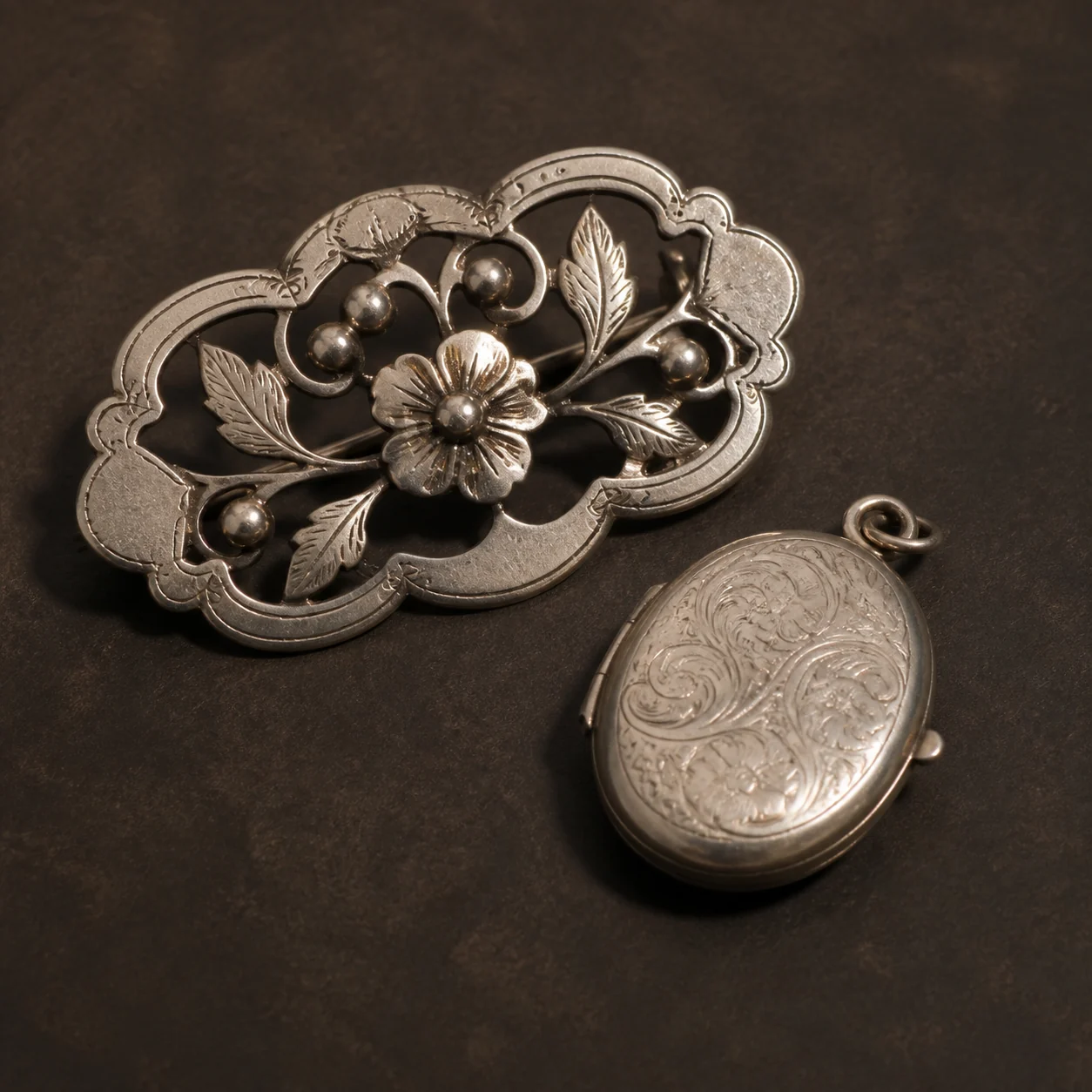
Decode Assay, Maker and Date Clues
In systems with grouped marks, an assay or town mark can point to a testing office, while a standard mark records the fineness accepted by that system. A sponsor's mark may identify the party who submitted an item rather than the person who made every component. A date letter or other date device can narrow a period only after its alphabet, shape and assay office are known. The State Library Victoria guide summarizes this useful four-part question set as where, what, when and who.
Record each mark as its own item before using a database. Search the exact transcription with a country or office clue, then compare the outline and neighboring marks. A similar animal, shield or initial can belong to a different period. Save the reference page and note whether it shows an example, a date range or a legal definition. Do not copy a date from a visually similar mark without checking the complete group.
Administrative marks add another layer. A registration or duty mark may provide an earliest boundary, but the finished object can be made later, imported, repaired or assembled from older parts. Use cautious language such as consistent with the documented mark period or not earlier than the registration date until independent evidence agrees.
- Make a numbered list of every punch and keep the original order.
- Identify the likely country or assay office before selecting a date-letter chart.
- Compare the whole mark group, not a single familiar icon.
- Keep a source note for each conclusion so another reader can reproduce the check.
Compare Regions Without Over-Dating an Item
Hallmark systems are local. A British silver group, a French responsibility mark, a European fineness number and an American retailer stamp do not answer the same questions. Even within one country, laws and conventions changed, offices opened or closed, and imported objects could receive additional marks. This is why a broad search for jewelry hallmark images can produce several plausible but incompatible answers.
Use a regional source that explains its scope. Official assay-office guidance is useful for definitions and current services; library or society guides can help with historical mark families; a specialist database may show visual comparisons. Check whether the reference covers the metal, date range and object type you have. If the source does not say, keep the geographic conclusion provisional.
Imported jewelry needs extra care. A mark may describe the country of manufacture, the country of testing, the importer or the place where the item was sold. A missing local mark may reflect an exemption, a small component, wear or a different legal system. Avoid statements such as every item must have the same set of marks unless a current, jurisdiction-specific source supports them.
| Research situation | Safer wording | Next check |
|---|---|---|
| A clear purity number but no maker | The mark is consistent with a fineness convention | Inspect the clasp, shank, reverse and paperwork. |
| A maker symbol with no date | The symbol may narrow attribution | Compare documented versions across periods. |
| A mixed or imported mark group | The marks may reflect different jurisdictions | Identify each mark's role before dating. |
| A worn or copied punch | The reading is provisional | Use a physical test or specialist review when stakes are high. |
Use a Photo Research Workflow
A photo-led workflow is most useful when it turns an uncertain mark into a short list of questions. Upload a complete object view and the clearest hallmark close-up, then compare the suggested reading with your own transcription. If the result conflicts with the visible metal, construction or regional clue, treat that conflict as a prompt to retake the image rather than as a reason to choose the more exciting answer.
Keep the research record with the object. Save the original photos, the mark transcription, the source links you checked, the possible date range and the questions that remain open. For a sale, insurance decision or inheritance, add measurements, weight, condition notes and provenance documents. The more valuable the decision, the less reasonable it is to rely on a single image or a single database match.
- PrepareGather the whole-item photo, mark close-up, measurements, condition notes and any provenance.
- CompareUse the image result to generate candidates, then check the mark group against regional references.
- QualifySeparate observed facts, likely interpretations and unresolved questions in your notes.
- EscalateRequest an assay, appraisal or specialist opinion when the financial or legal decision matters.
Know When Hallmark Identification Is Not Enough
Hallmark identification can organize evidence, but it cannot certify that a piece is genuine, complete or worth a particular amount. A mark can be copied, moved to a replacement component, worn beyond recognition or interpreted incorrectly. Market value also depends on condition, design, maker demand, provenance, weight, current buyers and the channel where the item is sold.
Use a qualified professional when you need a physical metal test, a formal appraisal, an insurance document, a legal opinion, a high-value sale decision or an authentication assessment. Ask what the service covers, what evidence it requires and whether the written result is an appraisal, an assay report or an opinion. Keep the wording precise so a research estimate is never mistaken for a guarantee.
- Do not polish away a faint mark before it is photographed.
- Do not use a purity number alone to price an entire object.
- Do not describe a likely maker as confirmed without corroborating evidence.
- Do not treat an AI or database match as a formal authentication certificate.
Hallmark Identification FAQ
These answers cover the questions people usually ask before they compare a jewelry or silver mark with a reference.
Can a photo identify a jewelry hallmark?
A clear photo can help transcribe a mark and suggest research candidates. It cannot reliably prove the metal, maker, age or authenticity because wear, glare, replacement parts and copied punches can change what the image appears to show.
What is the difference between a hallmark and a maker's mark?
A hallmark commonly refers to a set of marks connected with metal fineness and a marking or assay system. A maker's, sponsor's or importer mark identifies a responsible party. The terms can appear together, but a maker logo alone is not automatically a complete hallmark.
Does 925 prove that a piece is sterling silver?
925 is a widely used fineness clue, but it is not a complete authentication result. Check the wording, surrounding marks, construction, condition and the rules of the relevant market. A physical test may still be appropriate for a valuable or disputed item.
Can a date letter give the exact year?
A date letter can narrow a year only when its alphabet, shape, assay office and mark group are identified correctly. Similar letters can repeat in different cycles, and an object may be made, repaired or assembled later than the mark suggests.
What should I do if a hallmark is missing?
Photograph the likely mark locations, record the object and components, and note any wear or repair. A missing mark does not prove base metal or forgery. If the stakes are high, arrange a specialist review or physical test rather than guessing from a blank surface.
Can hallmark identification tell me what my jewelry is worth?
It can contribute to a research estimate by clarifying metal and possible attribution, but value also depends on condition, rarity, provenance, design demand and selling channel. Use an appraisal or specialist market advice when you need a formal valuation.
Ready for the next check?
Turn a hallmark photo into a research question
Upload the whole item and the clearest mark detail to organize possible readings, evidence gaps and the next photo worth taking. Keep the result as research guidance, not a certificate.
Analyze an Item View Research Options